Blog
Persian Rug vs Oriental Rug: What’s the Difference? Complete Guide (2026)


Persian Rug vs. Oriental Rug: What’s the Real Difference — and Does It Affect Value?
Walk into almost any rug showroom and you’ll hear the terms “Persian rug” and “Oriental rug” used as if they mean the same thing. Search online and the confusion only deepens — listings labeled “Oriental” sometimes show unmistakably Persian designs, while others labeled “Persian” turn out to be from somewhere else entirely.
This mix-up isn’t just a minor labeling issue. For anyone buying a handmade rug — whether for a living room centerpiece or a long-term collection — understanding the actual relationship between these two terms changes how you evaluate quality, provenance, and price.
Here is the short version: one of these terms describes a place of origin, and the other describes a much larger category that place belongs to. The longer version — the part that actually matters when you’re standing in front of a rug deciding whether it’s worth the asking price — is everything below.
Oriental Rug: The Umbrella Term for an Entire Weaving World
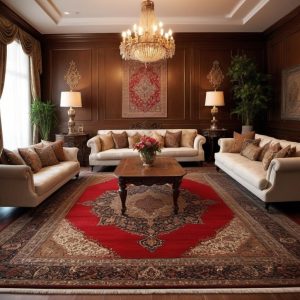
“Oriental rug” is a geographic and historical umbrella term. It refers to any handmade, hand-knotted rug produced across a broad swath of Asia — a tradition that spans multiple countries, cultures, and centuries.
Countries that produce rugs falling under the Oriental rug umbrella include Iran, Turkey, India, Pakistan, Afghanistan, China, and Nepal, among others. Each of these regions developed its own weaving techniques, design vocabularies, wool sources, and dye traditions — which is part of why “Oriental rug” as a category covers an enormous range of looks, from the bold geometric tribal pieces of Afghanistan to the silk-detailed florals of certain Chinese workshops.
The single unifying thread across all of these traditions is the hand-knotting technique itself — a method of construction where each knot is tied individually around the warp threads, building the pile of the rug row by row. This is what separates a true Oriental rug, regardless of country, from a machine-made or tufted imitation.
Persian Rug: A Specific, Protected Term for Rugs Woven in Iran
A Persian rug is, by definition, a handmade rug woven in Iran — historically known as Persia, hence the name. Put simply: every Persian rug is an Oriental rug, but the reverse is not true. An Oriental rug from Turkey, India, or Afghanistan is not a Persian rug, no matter how similar its design might look.
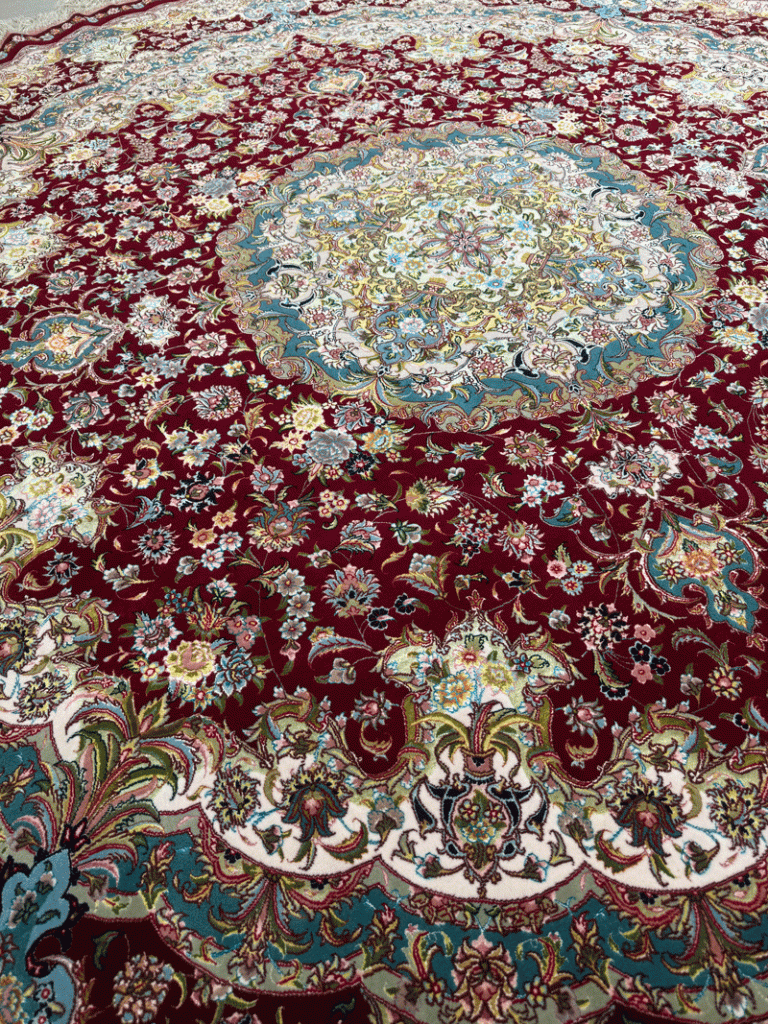
What sets Persian rugs apart within the broader Oriental rug world is the depth and consistency of Iran’s weaving tradition. Certain Iranian cities became so closely associated with particular weaving styles, materials, and quality standards that their names became shorthand for entire categories of design. Tabriz, Isfahan, Kashan, Qom, Nain, and Kerman are among the most internationally recognized of these weaving centers — each with its own signature look, whether that’s the dense medallion compositions of Tabriz, the refined symmetry of Isfahan, or the silk brilliance often associated with Qom.
This regional specialization is part of why Persian rugs, as a group, occupy such a prominent position in the global handmade rug market. The tradition isn’t just old — it’s structured, with generations of accumulated knowledge about design, materials, and technique passed down within specific weaving communities.
Persian Rug vs. Oriental Rug: A Side-by-Side Comparison
The table below summarizes how these two terms relate — and where the real points of distinction lie when you’re comparing an Iranian-made rug against an Oriental rug from elsewhere.
| Aspect | Persian Rug | Oriental Rug (General) |
| Origin | Made exclusively in Iran | Made across Iran, Turkey, India, Pakistan, Afghanistan, China, Nepal, and more |
| Relationship | A specific subset of Oriental rugs | The broad category that Persian rugs belong to |
| Design Range | Medallions, florals, hunting scenes, pictorial/tableau designs | Highly varied — includes Persian styles plus tribal, geometric, and regional motifs |
| Notable Centers | Tabriz, Isfahan, Kashan, Qom, Nain, Kerman | Varies by country (e.g., Hereke in Turkey, Bukhara patterns in Central Asia) |
| Typical Materials | Fine wool, silk, wool-silk blends, natural dyes | Wide range — quality varies significantly by region and workshop |
| Collector Reputation | Often regarded as a benchmark for fine hand-knotted weaving | Strong reputation overall, with certain regions and pieces highly collectible |
As the table makes clear, the comparison isn’t really “Persian vs. Oriental” in the sense of two competing categories — it’s more accurate to think of it as “Persian, plus everything else within Oriental.” The interesting comparisons happen when you place a Persian rug next to an Oriental rug from a different specific region — say, a Tabriz piece next to a Turkish Hereke or an Afghan tribal rug.
Design Philosophy: Why Persian Rugs Often Look Different from Other Oriental Rugs
One of the most noticeable differences when comparing rugs from different regions is design philosophy — not because one tradition is “better,” but because each developed around different artistic priorities.
Persian rugs, particularly from cities like Tabriz and Isfahan, are closely associated with curvilinear, courtly design traditions — intricate medallions, dense floral vine work, and in some cases full pictorial scenes drawn from Persian poetry, garden imagery, or historical narratives. These designs often trace back to court workshops, where weaving was treated as a fine art alongside painting and miniature illustration.
Many other Oriental rug traditions, by contrast, lean toward geometric and tribal design vocabularies — bold diamond patterns, stepped medallions, and symbolic motifs passed down through nomadic and village weaving communities rather than court workshops. These rugs have their own deep artistic value and often carry strong collector interest, particularly antique tribal pieces, but the visual language is fundamentally different from the curvilinear elegance typically associated with fine Persian weaving.
Neither approach is objectively superior — they represent different artistic lineages. But if you’re trying to identify whether a rug is likely Persian or from elsewhere, design style is often your first visual clue, even before checking labels or paperwork.
Craftsmanship and Materials: Where Reputation Meets Reality
Persian rugs have built an exceptionally strong reputation for craftsmanship, and in many cases that reputation is well-earned. Cities like Tabriz developed structured quality systems — the Raj measurement for knot density being one example — that gave the market a shared language for evaluating fineness. High-end Persian rugs frequently use premium hand-spun wool, silk highlights, and natural dyes that age beautifully over decades.
That said, it would be inaccurate to suggest that craftsmanship quality is exclusive to Persian rugs. Turkish Hereke silk rugs are renowned for extraordinarily fine knotting. Certain Caucasian and Central Asian tribal weaving traditions produce pieces with remarkable durability and bold, sophisticated color work using natural dyes. High-quality hand-knotted rugs exist across the entire Oriental rug category — Iran simply has one of the deepest, most consistently documented traditions of producing them at scale across multiple regional centers.
For buyers, the practical takeaway is this: “Persian” is not automatically synonymous with “highest quality.” A poorly made rug woven in Iran is still a poorly made rug, and an exceptional hand-knotted piece from Turkey or the Caucasus can outperform a mediocre Persian rug in every meaningful respect. Origin tells you about tradition and likely design vocabulary — it doesn’t substitute for evaluating the individual piece on its own merits.
Does Origin Affect Investment Value?
Within the collector and investment-focused segment of the rug market, origin does play a role — but mainly because certain regions have built long, well-documented track records at auction and through specialist dealers.
Persian rugs, especially antique and semi-antique pieces from recognized centers like Tabriz and Isfahan, have an established history in international auction markets, which gives buyers and appraisers more comparable sales data to reference. This documented history is part of why Persian rugs are frequently cited as a benchmark within the broader handmade rug investment conversation.
However, exceptional pieces from other Oriental rug traditions — antique Caucasian rugs, fine Turkish silk Herekes, certain rare tribal weavings — also command strong prices among specialist collectors, sometimes exceeding average Persian pieces of similar age. The strongest predictor of value, across any origin, remains the combination of knot density, materials, design rarity, condition, and provenance discussed in detail in our investment-focused guides. Origin is one input among several, not a value guarantee on its own.
How to Tell Where a Rug Was Actually Made
If a seller’s label simply says “Oriental rug” without specifying a country or city, there are a few practical ways to narrow things down.
Examine the back of the rug. The structure of the knots — whether symmetrical (Turkish/Ghiordes) or asymmetrical (Persian/Senneh) — can indicate the weaving tradition used, since different regions historically favored different knotting techniques. A rug with consistent asymmetrical knots and a curvilinear floral design is more likely to be Persian than one with symmetrical knots and bold geometric patterns, which leans toward Turkish or Caucasian traditions.
Look at the wool and dye character. Persian rugs from cities like Kashan are known for particularly fine, lustrous wool, while certain Afghan and Central Asian rugs use heavier, more rustic wool suited to their bolder designs. Natural dye colors also vary regionally — certain reds, blues, and golds are more strongly associated with specific weaving traditions.
When in doubt, ask for documentation. Reputable dealers should be able to provide information about a rug’s likely origin based on structural analysis, even when an exact provenance isn’t documented. For higher-value purchases, this kind of expert assessment is worth requesting before you buy.
Frequently Asked Questions: Persian vs. Oriental Rugs
Is it incorrect to call a Persian rug an ‘Oriental rug’?
No — it’s technically accurate, since Persian rugs are a subset of the Oriental rug category. However, if you know a rug is from Iran, calling it “Persian” is more precise and gives more useful information about its likely design tradition and weaving centers. The confusion usually runs the other way: calling a non-Iranian Oriental rug “Persian” is the inaccurate use of the term.
Are Persian rugs always more expensive than other Oriental rugs?
Not necessarily. Price depends primarily on craftsmanship, materials, knot density, design rarity, age, and condition — not origin alone. A mass-produced or lower-quality Persian rug can cost less than an exceptional antique Turkish or Caucasian piece. Origin influences typical design style and historical market data, but it is not a price guarantee in either direction.
Can a rug be both ‘Persian’ and ‘tribal’?
Yes. While Persian rugs are often associated with court and city workshop traditions, Iran also has a significant nomadic and tribal weaving heritage — the Qashqai and Bakhtiari peoples, for example, produce rugs with bold geometric and tribal motifs that are still classified as Persian rugs because of their Iranian origin, even though their design language differs from the curvilinear floral style typically associated with cities like Tabriz or Isfahan.
Final Thoughts: Origin Is the Starting Point, Not the Whole Story
The relationship between “Persian rug” and “Oriental rug” ultimately comes down to a simple nesting: one is a country-specific term, the other is the broad category that country’s weaving tradition belongs to alongside many others. Knowing this helps you read listings more accurately and ask better questions when shopping.
But origin alone won’t tell you whether a specific rug in front of you is a worthwhile purchase. That comes down to the knotting technique, the materials, the design execution, the condition, and — for anyone buying with collecting or investment in mind — the documentation behind the piece.
Whether you ultimately choose a Persian rug from a historic weaving center like Tabriz or an exceptional hand-knotted piece from another Oriental rug tradition, understanding this distinction puts you in a far stronger position to recognize genuine craftsmanship — and to choose a piece that will mean something for years to come.