Blog
Why Serious Collectors Are Treating Handmade Persian Rugs as Alternative Investment Assets

Beyond Decoration: Why Serious Collectors Are Treating Handmade Persian Rugs as Alternative Investment Assets
Something quiet has been happening in the world of tangible assets over the past two decades. Alongside fine art, rare wine, and vintage watches, a much older category has been drawing steady attention from collectors, wealth managers, and luxury buyers with a long view: handmade Persian rugs.
This is not a trend born from novelty. Persian rugs have functioned as stores of value across cultures and centuries. What is different now is that a new generation of sophisticated buyers — armed with better market data and a sharper eye for authenticity — is recognizing what experienced collectors have always known: a genuinely exceptional hand-knotted Persian rug is not a purchase that depreciates. It is an asset that deepens in meaning and, frequently, in monetary value over time.
So what exactly positions handmade Persian rugs within the alternative investment conversation? And what separates a piece worth owning for decades from one that simply looks the part?
Why Tangible Assets Matter — Especially When Markets Are Uncertain
The appetite for physical assets tends to grow when financial markets feel unpredictable. Stocks, bonds, and digital assets can lose significant value quickly. Tangible assets — things with intrinsic worth that exist independently of market sentiment — have long served as a counterweight in diversified portfolios.
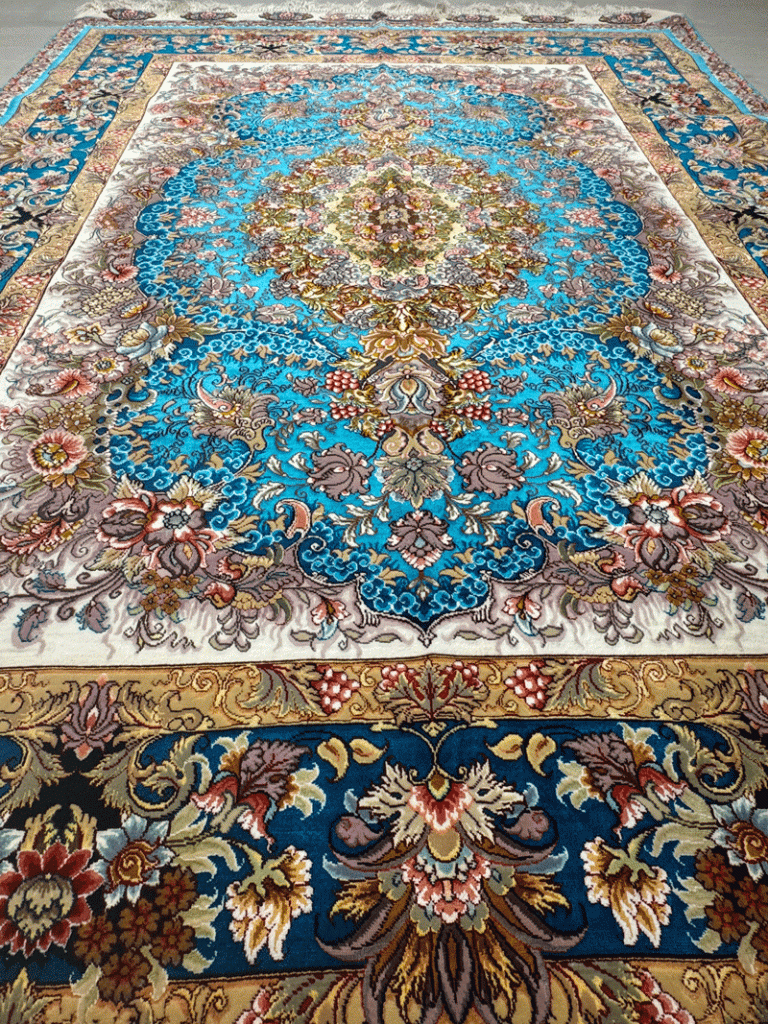
Fine art has occupied this role for decades. So have rare gemstones, classic automobiles, and luxury real estate. Handmade Persian rugs belong in this same conversation, and in certain respects they hold a structural advantage over some of their counterparts: they are both portable and functional. A collector who owns a museum-quality hand-knotted Tabriz or Kashan rug can use it daily, display it as the defining piece of a room, and still hold a genuinely appreciating asset beneath their feet.
That dual role — living object and long-term store of value — is one of the qualities that makes exceptional Persian rugs stand apart from almost any other alternative investment category.
The Scarcity Argument: Why Authentic Production Cannot Be Scaled Up
Every serious conversation about Persian rug investment eventually arrives at the same fundamental point: genuine handmade rugs cannot be mass-produced without ceasing to be what they are.
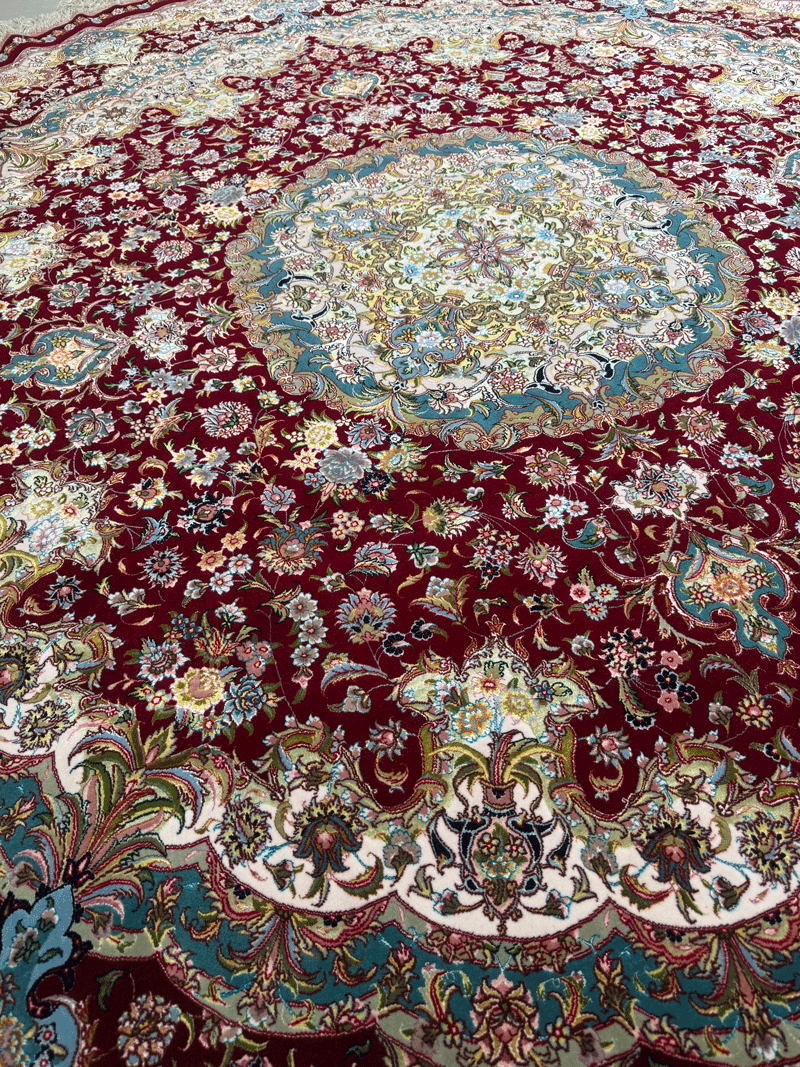
A fine hand-knotted Persian rug from a traditional city workshop — Tabriz, Isfahan, Kashan, or Qom — is the product of months or years of a single weaver’s life. The knot count in a collector-grade piece can exceed one million knots per square meter, each one placed individually by hand. No industrial process replicates this. Machine-made rugs can imitate the look of traditional designs at low cost, but they carry none of the scarcity, craftsmanship, or cultural authenticity that drive long-term value.
What makes this scarcity increasingly significant is that authentic production is actively declining. The number of master weavers still practicing traditional hand-knotting is smaller today than a generation ago. Weaving workshops in cities like Tabriz have closed or scaled back under economic pressure. The result is straightforward: the global supply of genuinely investment-grade handmade Persian rugs is contracting while global awareness of their value continues to grow.
What Makes a Persian Rug Investment-Grade? Six Factors That Actually Matter
The phrase ‘investment-grade’ gets applied loosely in the rug market, which is why knowing how to evaluate a piece — or at least what to ask a specialist — is essential. These are the six factors that consistently separate collectible, appreciating Persian rugs from attractive decorative pieces.
1. Weaving Method and Knot Density
Hand-knotted construction is non-negotiable for investment purposes. Tufted, machine-made, or hand-loomed rugs do not carry the same rarity or craftsmanship. Within hand-knotted rugs, knot density — measured in KPSI (Knots Per Square Inch) or Raj in Tabriz rugs — is a strong indicator of technical fineness. The higher the density, the more intricate the design can be and the greater the skill required from the weaver.
2. Materials: Wool, Silk, and Natural Dyes
Investment-grade rugs are woven with premium natural materials. Fine hand-spun wool, pure silk, or silk-highlighted wool blends all signal quality. Equally important is the dye source: rugs colored with natural plant and mineral dyes develop a patina over decades that synthetic dyes simply cannot replicate. That aging process — the way natural colors mellow and deepen — is part of what makes antique Persian rugs so visually compelling and collectible.
3. Origin and Workshop Reputation
Where a rug comes from matters enormously. Tabriz, Isfahan, Kashan, Qom, and Kerman are among the most respected weaving cities, each with distinct traditions and quality standards. Within those cities, certain workshops and master weavers carry reputations that directly affect market value. A signed piece from a recognized master commands a premium that an unsigned rug of similar density cannot match.
4. Design Rarity and Artistic Originality
Unique or rare designs consistently outperform generic patterns in the collector market. Pictorial rugs and tableau carpets — those depicting figural scenes, Persian literary narratives, or singular compositions — attract particularly strong interest because they are effectively one-of-a-kind artworks. The more distinctive and skillfully executed the design, the narrower the field of comparable pieces and the stronger the long-term value proposition.
5. Age and Provenance
Antique Persian rugs (80 years or older) and semi-antique pieces with documented histories occupy the highest tier of collector interest. Provenance — a paper trail connecting a rug to a specific workshop, collector, or auction record — adds measurable value by confirming authenticity and giving future buyers confidence. For serious investment purposes, documented pieces are always preferable.
6. Condition and Preservation
Even the rarest rug loses significant value if poorly maintained. Full pile, original colors, intact borders, and the absence of major repairs all contribute to market value. Professional cleaning, proper storage away from direct sunlight, and the use of quality rug pads are not simply maintenance decisions — they are investment decisions.
Persian Rugs vs. Other Alternative Investments: An Honest Assessment
It is worth placing Persian rugs honestly within the broader alternative investment landscape rather than overstating the case.
Fine art is the closest comparison. Like significant paintings and sculptures, exceptional handmade rugs are unique or near-unique objects whose value is shaped by authorship, rarity, condition, and provenance. Both categories have produced strong long-term returns for informed collectors, and both carry the same central challenge: illiquidity. Selling a significant rug — like selling a significant painting — requires finding the right buyer at the right moment, which can take time.
The honest summary is this: handmade Persian rugs are not a liquid asset and they are not a short-term play. They are best understood as long-horizon holdings for buyers who appreciate the object itself — its beauty, cultural depth, and craftsmanship — and who are prepared to hold for years or decades to realize the full investment case.
Where Global Demand Is Growing — and Why It Shows No Sign of Slowing
The collector market for investment-grade Persian rugs is genuinely international and has been broadening steadily. Established buyer bases in North America, Western Europe, and the Gulf states have been joined by growing collector communities in East Asia, Australia, and South America as global wealth expands and appreciation for handmade craftsmanship rises.
This demand shift is partly cultural. A generation of buyers raised on fast furniture and disposable interiors is actively seeking objects with permanence, story, and human origin. A hand-knotted Persian rug is the direct opposite of disposable design: made slowly, by hand, using techniques refined over centuries, it will outlast almost everything else in the room. That narrative resonates strongly with buyers who have the means to choose it.
Major international auction houses continue to see strong results for significant Persian rugs, and specialist dealers in cities from London to Dubai to New York report sustained interest from buyers entering the market with a clear investment mindset alongside their decorative one.
How to Approach Persian Rug Investment Wisely
Entering the Persian rug market with an investment mindset requires a different kind of attention than buying purely for decoration. A few practical principles consistently help first-time investment buyers navigate it well.
Buy the best single piece your budget allows rather than spreading across several average examples. One outstanding hand-knotted Persian rug from a respected weaving tradition will consistently outperform a collection of mediocre pieces over time. Quality concentration matters far more than quantity in this market.
Work with specialists, not generalists. A reputable dealer or auction house with a documented track record in Persian and Oriental rugs will provide access to provenance documentation, honest condition assessments, and market knowledge that no online listing can replicate. The specialist relationship is part of the investment infrastructure.
Think in decades. The buyers who have done best in the Persian rug market are those who approached it as a long-term holding, cared for their pieces properly, and were not in a hurry to sell. That patience, combined with genuine quality at acquisition, is the most reliable formula the market offers.
Frequently Asked Questions About Persian Rugs as Alternative Investments
Do Persian rugs actually increase in value over time?
Investment-grade handmade Persian rugs — particularly antique pieces, master-signed works, and rugs with strong provenance from respected weaving cities — have historically maintained or increased in value over the long term. The critical qualifier is quality: not every Persian-style rug appreciates. Machine-made reproductions and low-grade handmade pieces do not carry the same value trajectory as genuinely exceptional, authenticated hand-knotted rugs from traditional weaving centers.
What is the difference between a Persian rug and an Oriental rug?
The term ‘Oriental rug’ refers broadly to hand-knotted rugs produced across a wide geographic region spanning Central Asia, the Middle East, and parts of South Asia. Persian rugs are a subset of Oriental rugs — specifically those originating from Iran — and are generally considered the most prestigious within that broader category, particularly pieces from historically significant weaving cities such as Tabriz, Isfahan, Kashan, and Qom.
How should I store or display a Persian rug I am treating as an investment?
Keep the rug away from prolonged direct sunlight, which fades natural dyes irreversibly over time. Use a quality rug pad to reduce friction and fiber stress on the foundation. Rotate the piece annually if it sits in a high-traffic area to distribute wear evenly. Have it professionally cleaned by a specialist in Persian and Oriental rugs every three to five years — never use steam cleaning or a domestic washing machine on a hand-knotted rug. For pieces held in storage, roll rather than fold, and keep in a cool, dry, well-ventilated space.
Final Thoughts: An Asset That Was Never Simply Decorative
Persian rugs have been traded as stores of value since long before the concept of alternative investment existed as a financial category. Merchants carried them across continents. Rulers exchanged them as diplomatic currency. Collectors held them across generations precisely because they understood that exceptional handmade craftsmanship does not age out of relevance.
What has changed is that the language of investment has finally caught up to what serious rug collectors have always quietly practiced. The scarcity is real. The craftsmanship is irreplaceable. Global demand is growing. And the pieces that genuinely meet the bar — authenticated, hand-knotted, beautifully preserved, from respected weaving traditions — continue to occupy a rare position: objects that enrich every space they inhabit while holding their own as long-term assets.
For anyone willing to learn the market carefully and buy with genuine quality in mind, a handmade Persian rug remains one of the most human and enduring investments available today.