

Blog
How to Identify an Authentic Persian Rug


A Complete Guide for Collectors, Designers, and Luxury Rug Buyers
In today’s market, authentic handmade Persian rugs are becoming increasingly rare. At the same time, mass-produced imitations are everywhere.
To an untrained eye, many rugs may appear similar online. But experienced collectors and interior designers know that a genuine Tabriz rug has a character, depth, and craftsmanship that machine-made copies simply cannot reproduce.
Whether you are buying your first Persian rug or adding to a private collection, understanding how to identify an authentic Tabriz rug is essential.
This guide explains the most important signs of authenticity and what truly separates a luxury handmade Persian carpet from an imitation.
Why Authenticity Matters
A real Tabriz rug is more than decoration.
It represents:
- generations of craftsmanship,
- months or years of hand weaving,
- artistic heritage,
- and lasting value.
Authentic Persian rugs often become heirloom pieces that remain beautiful for decades. In contrast, machine-made rugs are manufactured quickly, lose value over time, and rarely carry the same artistic or emotional presence.
For collectors and luxury homeowners, authenticity is everything.
The Origin of Tabriz Rugs
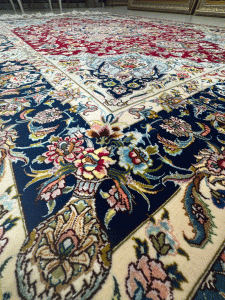
Tabriz is one of the oldest and most respected carpet-weaving centers in Iran. For centuries, master weavers in the city have created some of the finest Persian rugs in the world.
The city is especially famous for:
- exceptional knot precision,
- detailed floral and medallion patterns,
- luxury silk carpets,
- and artistic tableau rugs.
Because of this reputation, many factories and low-quality producers attempt to imitate Tabriz designs.
That is why learning how to recognize a genuine handmade Tabriz rug is so important.
Check the Back of the Rug
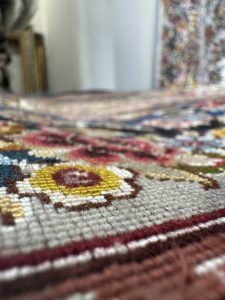
One of the easiest ways to identify a handmade Persian rug is to examine the backside.
In authentic Tabriz rugs:
- the pattern remains visible from the back,
- knots appear individually tied,
- and details stay sharp and clear.
Machine-made rugs usually have:
- uniform stitching,
- artificial backing,
- or overly perfect symmetry.
A handmade rug reveals the work of human hands. Small irregularities are natural and often indicate authenticity.
Understanding Knot Density
High-quality Tabriz rugs are known for their fine knot density.
The more knots per square inch, the more detailed and precise the design can become.
In Persian rug weaving, Tabriz carpets are often classified by “Raj,” a traditional measurement related to weaving fineness.
Higher Raj counts usually indicate:
- finer craftsmanship,
- greater detail,
- and higher value.
However, knot density alone does not determine quality. The artistry, materials, and balance of the design are equally important.
Look for Natural Materials
Authentic Persian rugs are typically made from:
- natural wool,
- silk,
- cotton foundations,
- and traditional dyes.
High-quality wool feels rich and soft while maintaining durability. Silk rugs reflect light beautifully and allow for extraordinary detail in the design.
Synthetic machine-made rugs often feel:
- stiff,
- overly smooth,
- or artificial.
Natural materials also age more gracefully over time, which is one reason handmade Tabriz rugs can remain beautiful for generations.
Pay Attention to the Colors
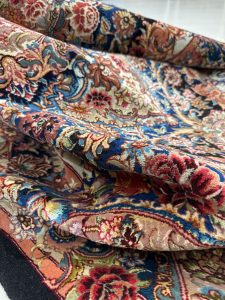
One sign of a genuine handmade Tabriz rug is depth in color.
Traditional Persian rugs often use natural dyes that create subtle variations throughout the carpet. These small changes in tone are called abrash and are highly appreciated among collectors.
Machine-made rugs usually appear too uniform because synthetic production removes these natural artistic variations.
In authentic rugs, colors feel alive rather than flat.
Handmade Rugs Are Never Perfect
Ironically, perfection can sometimes be a warning sign.
A handmade Tabriz rug may contain:
- slight asymmetry,
- tiny variations in pattern,
- or minor irregularities.
These details are not flaws. They are evidence of real craftsmanship.
Machine-made rugs are created with exact mechanical precision, while handmade Persian rugs carry the individuality of their weaver.
This uniqueness is part of what makes luxury handmade carpets so valuable.
The Difference in Artistic Detail

One of the defining features of authentic Tabriz rugs is artistic complexity.
Master weavers can create:
- floral gardens,
- medallions,
- hunting scenes,
- and even portrait-style tableau rugs
with extraordinary precision.
In fine silk Tabriz carpets, some designs resemble paintings more than textiles.
This level of artistry is extremely difficult for machine production to imitate convincingly.
Common Signs of Fake Persian Rugs
When shopping online or internationally, be cautious of rugs that:
- seem unusually cheap,
- claim to be handmade without detailed photos,
- use synthetic shine instead of real silk,
- or have glued backing materials.
Authentic handmade Persian rugs require significant time and skill to produce. True craftsmanship cannot be mass-produced at very low prices.
If a rug appears too inexpensive for its claimed quality, there is usually a reason.
Why Authentic Tabriz Rugs Remain Valuable
The world is moving toward mass production, automation, and disposable products.
But authentic Persian rugs represent the opposite:
- patience,
- artistry,
- tradition,
- and permanence.
That is why collectors, luxury interior designers, and art enthusiasts continue to seek genuine Tabriz rugs.
Every authentic piece carries something impossible to replicate:
the presence of human craftsmanship.
And in modern luxury, authenticity has become one of the rarest qualities of all.
Final Thoughts
A genuine Tabriz rug is not simply identified by a label or a price tag.
Its authenticity is visible in:
- the knots,
- the materials,
- the artistic detail,
- and the individuality woven into every piece.
For those who appreciate craftsmanship, heritage, and timeless design, an authentic handmade Persian rug remains one of the most meaningful luxury pieces a home can contain.
Because true artistry cannot be manufactured.


